
-
×
 Buzzer SFM-27 DC3-24V Wired Continuous Sound 90dB
1 × 220.00 ₨
Buzzer SFM-27 DC3-24V Wired Continuous Sound 90dB
1 × 220.00 ₨


ESP8266 – interesting platform for WiFi enabled projects
This small board can act as WiFi module for Arduino (or other µc – Teensy, Netduino, etc) or as standalone microcontroller. With RISC processor running at 80 MHz and with 4MB Flash You can do lot interesting projects. It has 9 GPIO pins to interact with other modules (OneWire, I2C, SPI).
ESP8266-12 technical details
- 9 GPIO ports, each PWM capable
- RISC processor 80MHz
- power supply 3.3V (3.6V max)
- logic levels 3.3V
- PCB antenna
- 4 MB of flasg
To program ESP You will need FTDI friend or USB/Serial converter. FTDI cable 3 V will work only if You provide other power source, FTDI cable, even 3V version has 5V at it’s power line.
W also carry adapter, which has all ESP GPIO in 2.54 raster – You can plug this adapter directly into breadboard or connect standard F-M cables.
Power supply During start and in some working modes ESP takes up to 220 mA of current. Not all USB/Serial converters will provide such current. In that case You will need some separate 3.3V source to power module. More on ESP8266 current consumption topic. TL;DR: module takes from 220 mA in 802.11b mode, through 130mA – 150 mA in n or g modes to single mA in power save modes.
What can I do with ESP8266-12?
This module works as WiFi gateway for other µcs, or as standalone node. Check this example (in polish) how we did connect DS18B20 temperature sensor to ESP8266-01, and it’s sending data to
To program this module You can use LUA language, just upload nodeMCU firmware and You are ready to go 🙂
Useful links
- nodeMCU fw on github
- AT commands nurdspace.nl
- ESP8266 Wiki
- Tool for firmware uploading: ESPLORER
- Open project SUPLA – home automation with ESP8266 and other modules
Module is great tool for application prototyping. ESP8266 chip has FCC certification, however not as this module (with PCB).
Be the first to review “ESP-8266-12E WiFi module with 9 GPIO”
Related products
Sale!


Arduino interface Module
Original price was: 770.00 ₨.750.00 ₨Current price is: 750.00 ₨.


Arduino interface Module
Price range: 2,500.00 ₨ through 2,800.00 ₨
This product has multiple variants. The options may be chosen on the product page
Sale!

Out of stock
Arduino interface Module
3.7V 3A LI-ION LITHIUM BATTERY 18650 CHARGER OVER CHARGE PROTECTION BOARD
Original price was: 66.00 ₨.55.00 ₨Current price is: 55.00 ₨.
Sale!


Arduino interface Module
Original price was: 605.00 ₨.440.00 ₨Current price is: 440.00 ₨.


Sale!

Arduino interface Module
Original price was: 7,000.00 ₨.6,500.00 ₨Current price is: 6,500.00 ₨.
Sale!
Arduino interface Module
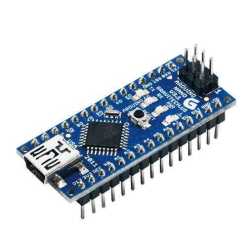
Arduino Nano V3.0 ATmega328P Micro Controller Board CH340 Chip
Original price was: 1,150.00 ₨.950.00 ₨Current price is: 950.00 ₨.


Arduino interface Module
Micro SD Card TF Card Module SPI Interface for Arduino, PIC, AVR, ARM
250.00 ₨
Sale!

Arduino interface Module
Price range: 150.00 ₨ through 4,250.00 ₨
Sale!

Out of stock
Arduino interface Module
Original price was: 5,500.00 ₨.5,280.00 ₨Current price is: 5,280.00 ₨.

Out of stock


Reviews
There are no reviews yet.